
The logical design of IoT explains how IoT devices communicate, exchange data, and provide services. It focuses on the software side of an IoT system, including communication models, functional blocks, APIs, and data flow instead of physical devices.
Introduction
Think about unlocking your door with your phone or getting a notification when your package arrives. These things happen because different devices can communicate and share information in real time. But have you ever wondered what makes that possible?
The answer is the logical design of IoT. It is the part of an IoT system that defines how devices connect, send data, process information, and deliver useful services. It acts like the brain behind the entire system.
Whether you are a student, developer, or someone curious about the Internet of Things, understanding the logical design will help you see how modern smart devices work together. Keep reading to learn the core concepts in a simple and easy way.
Key Takeaways
- Logical design focuses on how IoT devices communicate and exchange data.
- It defines communication models, functional blocks, APIs, and services.
- It helps build scalable, secure, and reliable IoT applications.
- Communication protocols like MQTT, HTTP, and CoAP play a key role.
- Understanding logical design makes it easier to develop and manage IoT solutions.
Logical Design of IoT at a Glance
| Feature | Description |
|---|---|
| Focus | Software architecture and communication |
| Purpose | Manage data flow between IoT devices and applications |
| Includes | Functional blocks, communication models, APIs |
| Used In | Smart homes, healthcare, agriculture, factories |
| Common Protocols | MQTT, HTTP, CoAP, AMQP |
| Main Goal | Reliable communication and efficient data processing |
What Is Logical Design of IoT?
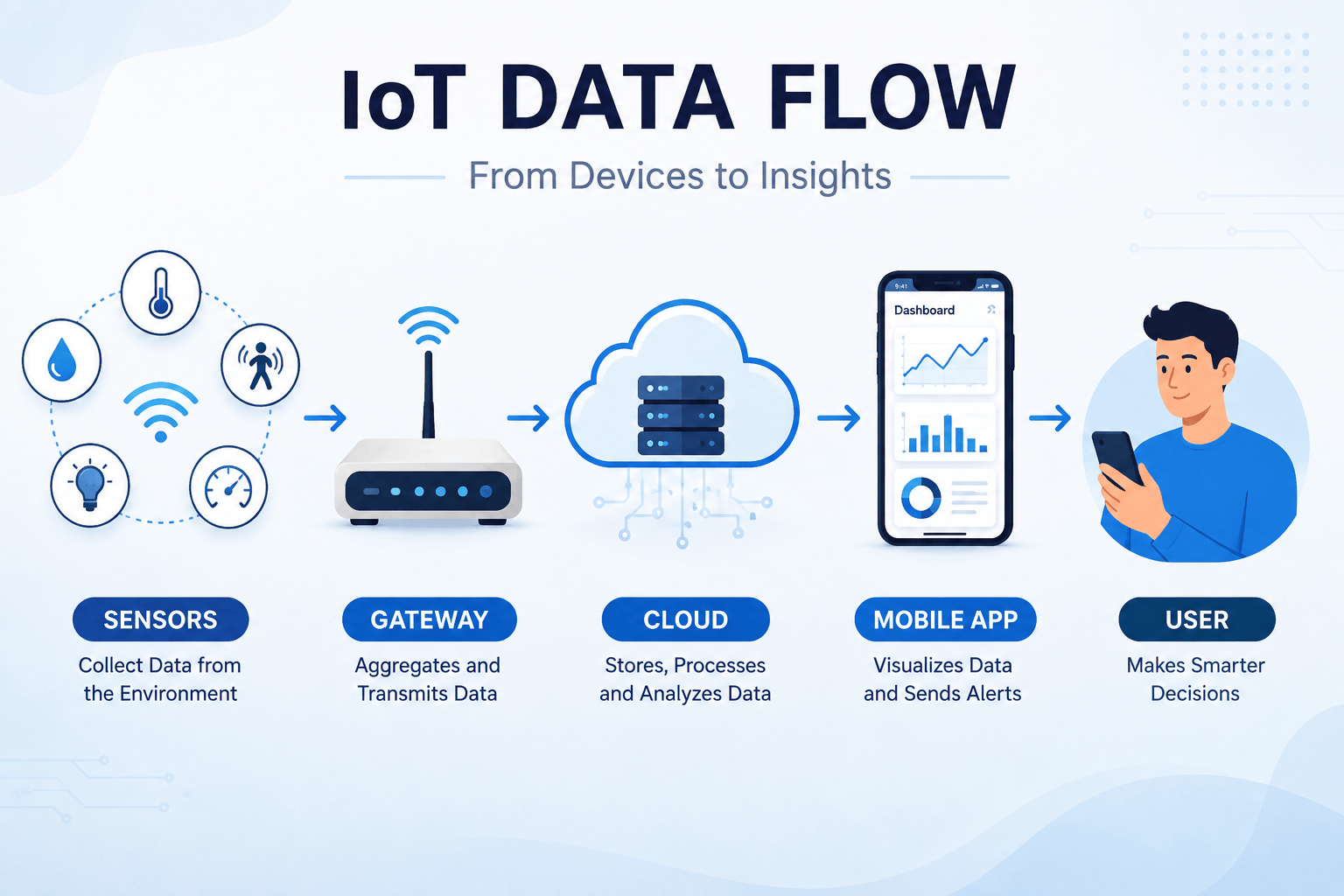
The logical design of IoT describes how different parts of an IoT system communicate and work together. Instead of focusing on the physical hardware, it explains how data moves from one component to another and how services are delivered to users.
Every IoT device generates information. That information must travel through networks, reach cloud servers, get processed, and finally appear in an application where users can interact with it. The logical design defines every step of this process.
In simple words, the logical design is the software blueprint of an IoT system. It tells every device what to do, how to communicate, and how to respond to requests.
For example, when a smart thermostat detects that the room temperature is too high, it sends the data to a cloud server. The cloud processes the information and sends instructions back to the air conditioner. The mobile app then shows the updated room temperature to the user. All these interactions are part of the logical design.
Without a proper logical design, devices would not know how to exchange information or perform actions automatically.
Why Is the Logical Design of IoT Important?
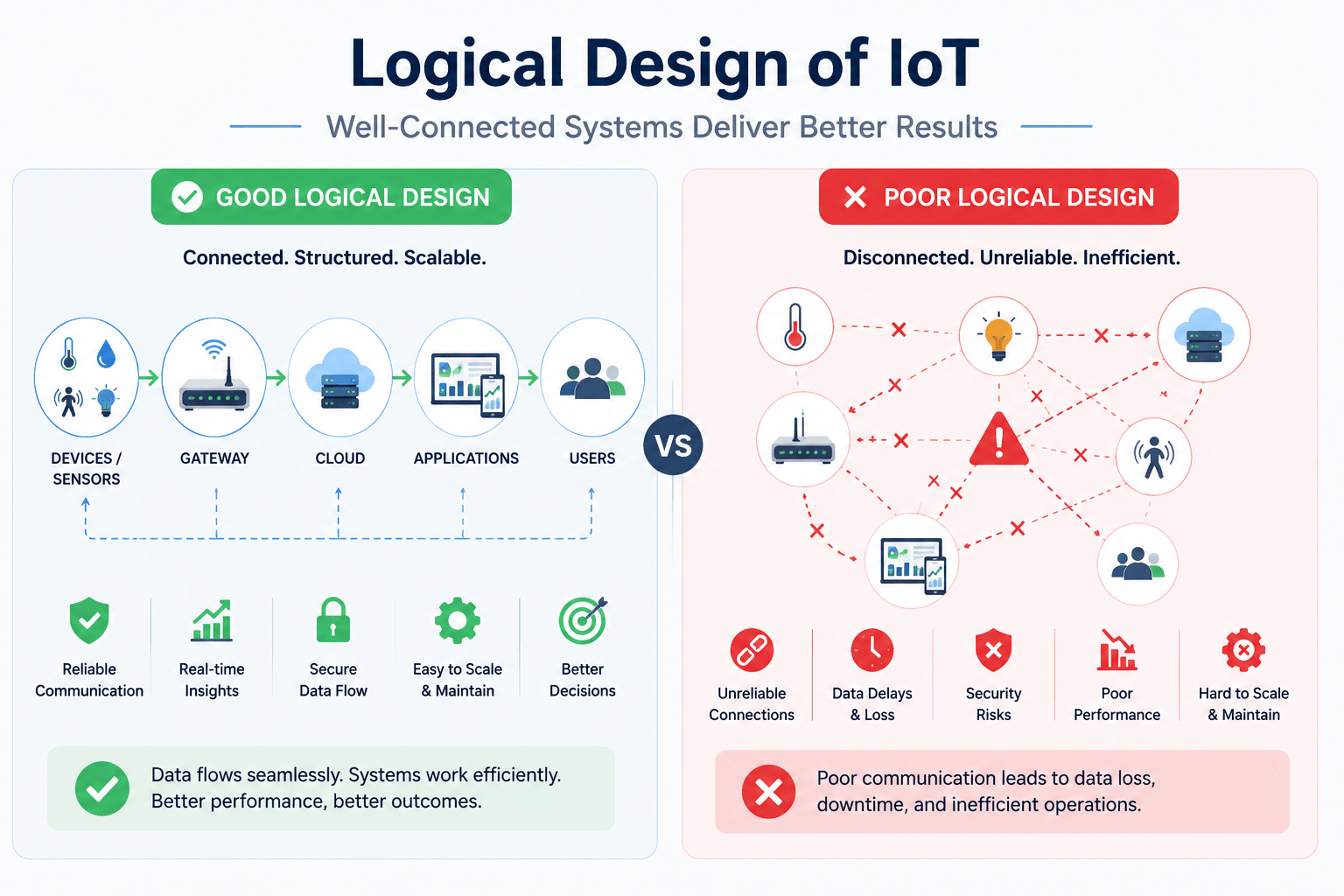
As IoT networks continue to grow, thousands or even millions of devices need to communicate without delays or errors. A good logical design makes this possible.
Here are some reasons why it is important.
Better Communication
Devices can exchange information quickly and accurately.
Easy Scalability
New devices can be added without changing the entire system.
Faster Data Processing
Information moves efficiently from devices to cloud applications.
Better User Experience
Users receive accurate information and faster responses.
Improved Security
Authentication, encryption, and access control help protect sensitive data.
Easier Maintenance
Developers can monitor devices, update software, and solve problems remotely.
Because of these benefits, logical design is considered one of the most important parts of any IoT architecture.
Main Components of the Logical Design of IoT
The logical design consists of several functional blocks. Each block performs a specific task that helps the IoT system operate smoothly.
1. Devices
Devices are the starting point of every IoT system.
They collect information from the physical environment using sensors or perform actions using actuators.
Examples include:
- Smart watches
- Temperature sensors
- Motion detectors
- Smart lights
- Security cameras
- GPS trackers
These devices continuously collect data and send it to other parts of the IoT system.
For example, a temperature sensor records the room temperature every few seconds and sends the readings to a cloud platform for analysis.
2. Communication
Communication allows IoT devices to exchange information with gateways, cloud servers, and applications.
Without communication, IoT devices would simply collect data without sharing it.
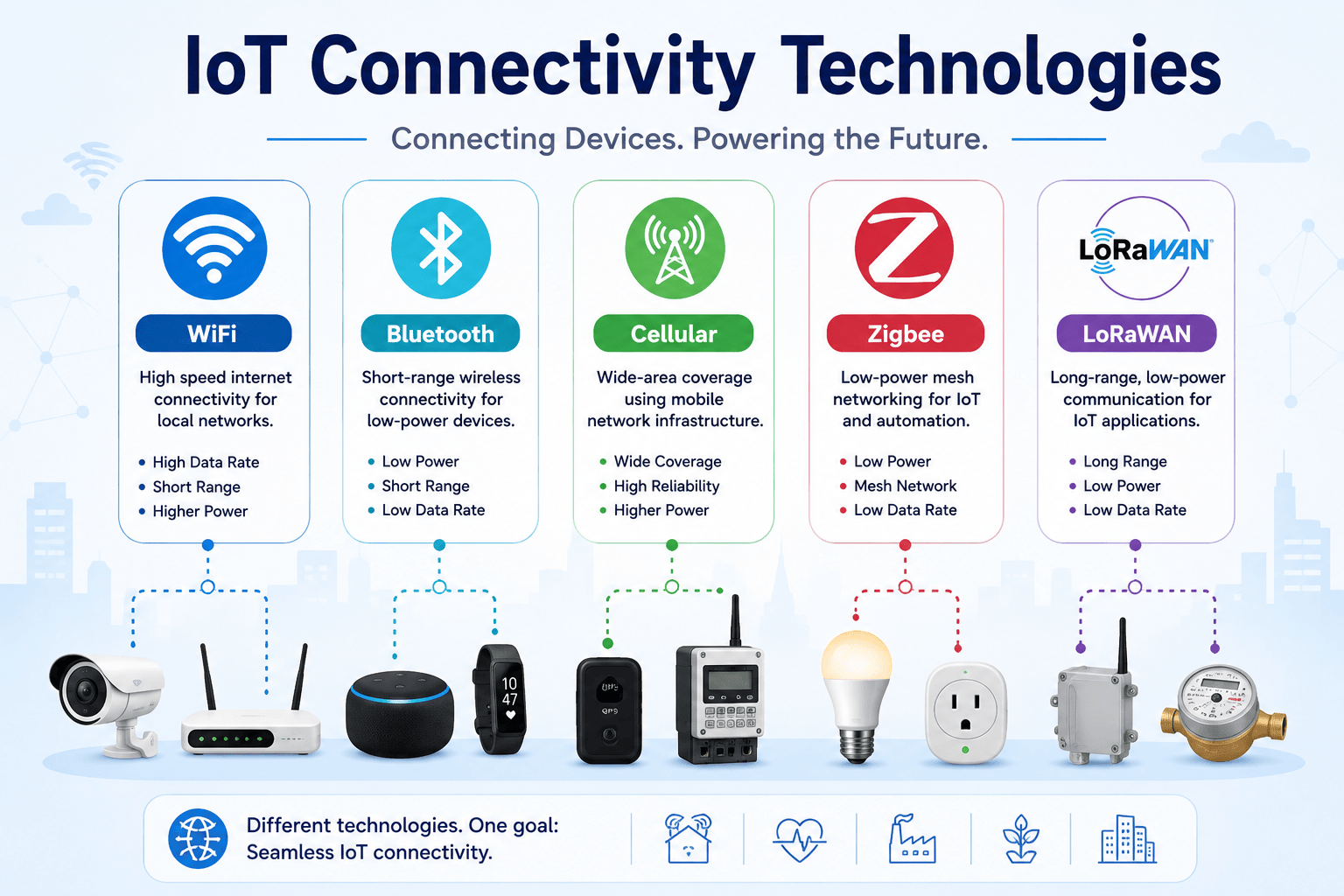
Some of the most common communication technologies include:
- WiFi
- Bluetooth Low Energy
- Zigbee
- Cellular networks
- Ethernet
- LoRaWAN
The choice depends on factors like range, speed, power consumption, and cost.
For example:
- Bluetooth works well for wearable devices.
- WiFi is common in smart homes.
- LoRaWAN is suitable for agriculture because it covers long distances while using very little power.
Communication is one of the most important parts of the logical design because it connects every component together.
3. Services
Services process the information received from IoT devices.
They are responsible for transforming raw sensor data into useful insights.
Common IoT services include:
- Data collection
- Data storage
- Analytics
- Event processing
- Notifications
- Automation
- Device monitoring
For example, a smart irrigation system collects soil moisture data and automatically turns on the water pump when the moisture level drops below a certain value.
The service layer makes these automated decisions without requiring human intervention.
4. Management
Managing thousands of IoT devices manually would be almost impossible.
The management block helps administrators monitor and control every connected device.
Typical management tasks include:
- Registering new devices
- Updating firmware
- Configuring devices
- Monitoring performance
- Detecting faults
- Removing inactive devices
Many cloud platforms allow these tasks to be completed remotely, saving both time and effort.
For example, a company with thousands of smart meters can update all of them through a cloud dashboard instead of visiting each location.
5. Security
Security is one of the biggest concerns in IoT.
Since IoT devices often handle sensitive information, protecting that data is essential.
The security block helps protect the system by providing:
- Authentication
- Authorization
- Data encryption
- Secure communication
- Identity management
- Access control
Imagine a smart door lock that anyone could access without authentication. It would create a serious security risk.
Strong security measures ensure that only authorized users and devices can access the system.
6. Applications
Applications are the part of the IoT system that users interact with every day.
These applications display information collected by IoT devices and allow users to control connected equipment.
Examples include:
- Smart home mobile apps
- Fitness tracking apps
- Industrial dashboards
- Smart farming platforms
- Healthcare monitoring systems
Applications convert technical data into charts, alerts, notifications, and reports that users can easily understand.
For example, a fitness application shows daily step counts, heart rate, calories burned, and sleep quality using data collected from a smartwatch.
How These Functional Blocks Work Together
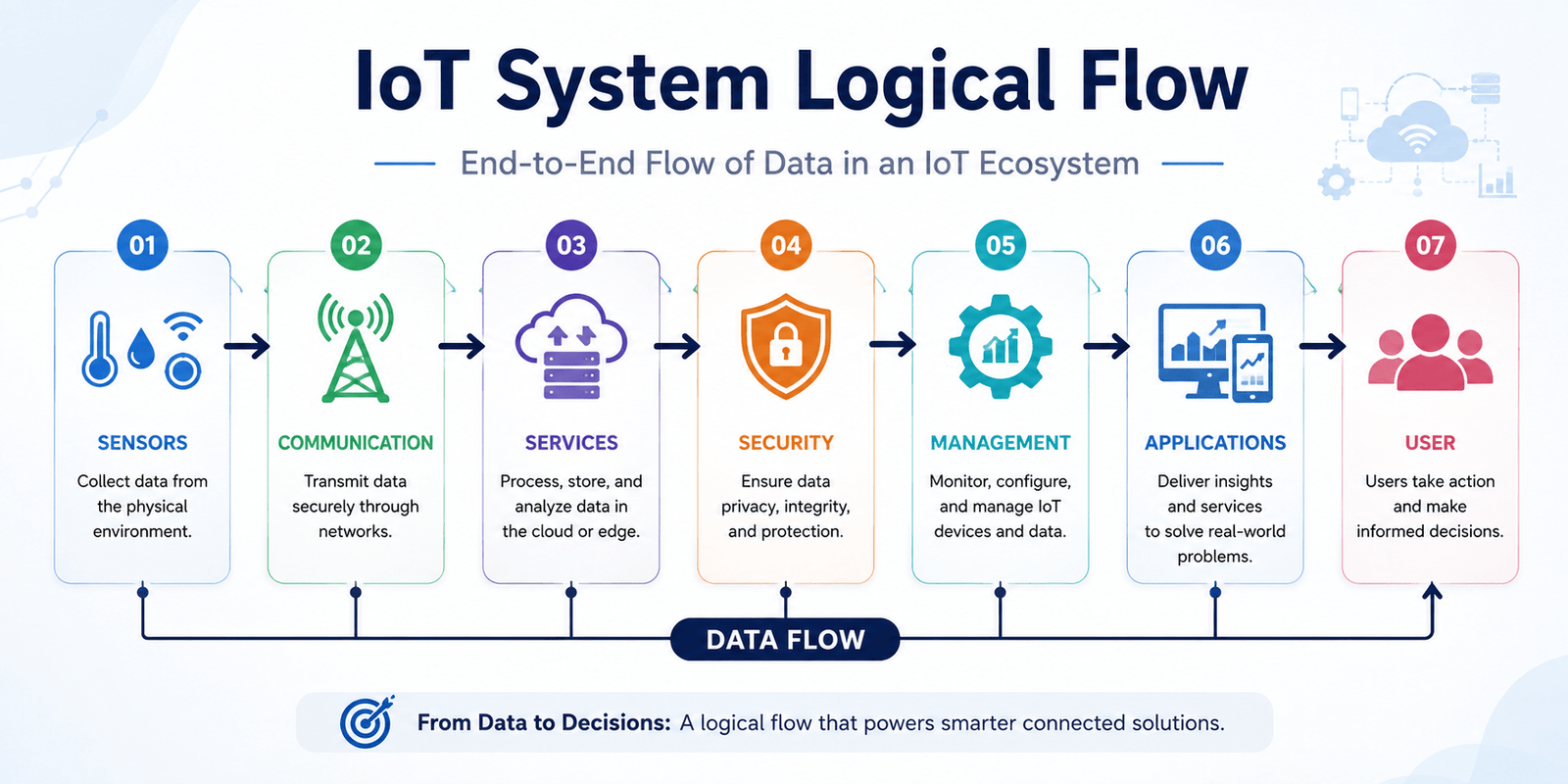
Each functional block has a specific responsibility, but they work together as one complete system.
The process usually follows these steps:
- Sensors collect data from the environment.
- Devices send the data through a communication network.
- Services process and analyze the information.
- Security verifies every request and protects the data.
- Management tools monitor and maintain the connected devices.
- Applications display the processed information to users.
This continuous flow allows IoT systems to operate automatically and respond in real time.
Communication Models in IoT
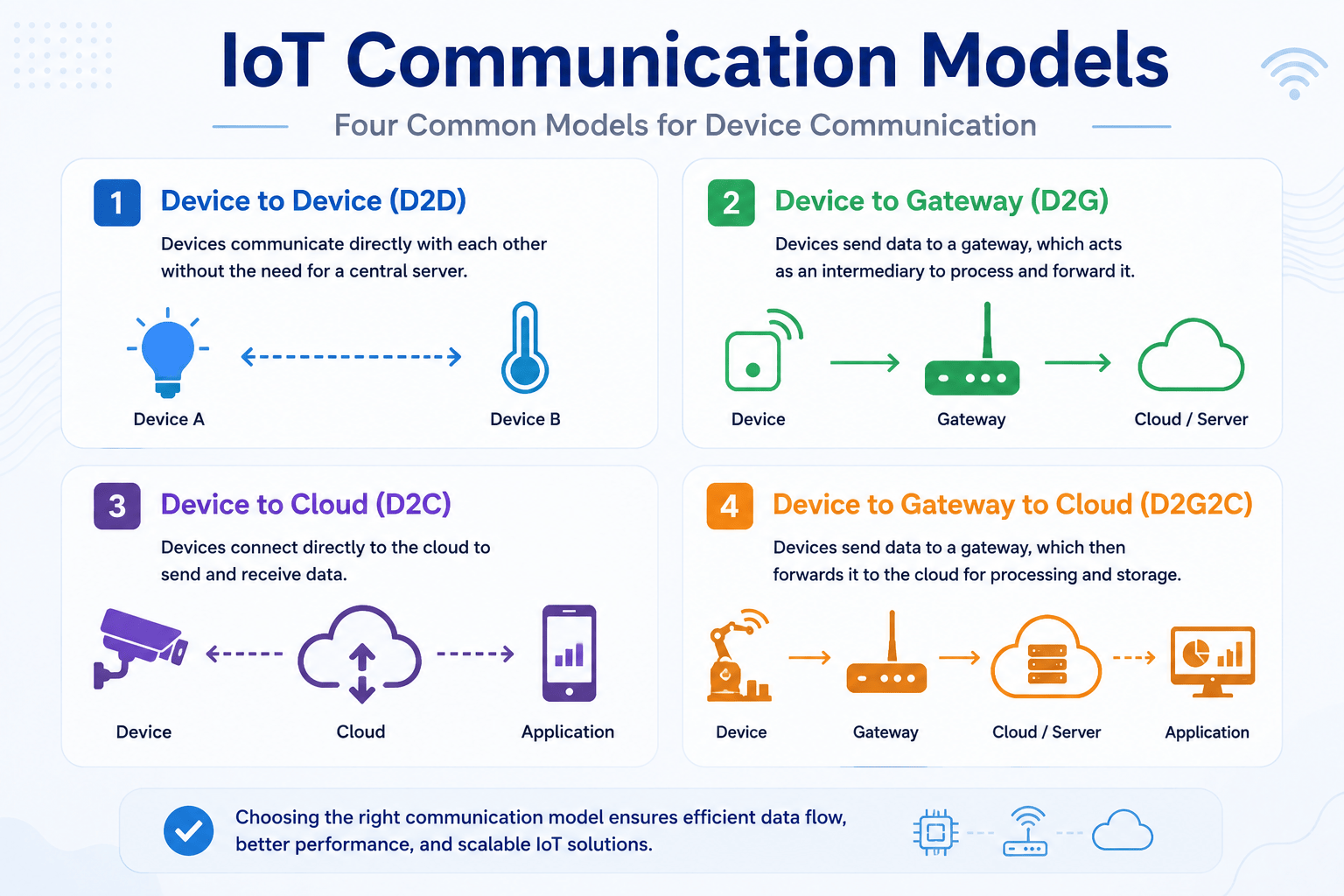
Communication models define how IoT devices exchange information with each other. Different applications require different communication methods depending on speed, reliability, and the amount of data being transferred.
The four most common communication models are explained below.
1. Request Response Model
The Request Response model is one of the simplest communication methods.
In this model, one device sends a request and waits for another device to respond.
It works much like browsing a website. Your browser requests a web page, and the server returns the requested information.
How it works
- A device sends a request.
- The server receives the request.
- The server processes the request.
- A response is sent back to the device.
Example
A smart thermostat requests the current weather from a cloud server before adjusting the room temperature.
Advantages
- Easy to implement
- Reliable communication
- Widely supported
Limitations
- Devices must wait for responses.
- Not suitable for continuous real time updates.
2. Publish Subscribe Model
The Publish Subscribe model is widely used in modern IoT systems.
Instead of sending information directly to every device, data is sent to a message broker. Devices that need the information subscribe to the topic and automatically receive updates.
How it works
- A device publishes data.
- The broker receives the message.
- Subscribers receive the update instantly.
Example
A weather station continuously publishes temperature data. Multiple mobile apps receive updates without directly contacting the weather station.
Advantages
- Supports many devices
- Fast data distribution
- Reduces network traffic
- Easy to scale
Limitations
- Requires a message broker.
- Slightly more complex than Request Response.
3. Push Pull Model
The Push Pull model separates data producers from data consumers.
One device pushes data into a queue, while another device pulls the data whenever it is ready to process it.
This model works well when large amounts of information need to be processed.
Example
Thousands of factory sensors send machine data to a processing server. The analytics system processes the data one batch at a time.
Advantages
- Efficient workload distribution
- Good for high volume data
- Improves system performance
Limitations
- Not designed for instant communication.
- Queue management adds complexity.
4. Exclusive Pair Model
In this model, two devices communicate directly with each other.
No third party server or broker is involved after the connection is established.
Example
Wireless earbuds connected to a smartphone using Bluetooth.
Advantages
- Fast communication
- Low latency
- Simple connection
Limitations
- Only supports one to one communication.
- Not suitable for large IoT networks.
Comparison of IoT Communication Models
| Communication Model | Best For | Scalability | Real Time Support |
|---|---|---|---|
| Request Response | Mobile apps | Medium | Moderate |
| Publish Subscribe | Smart cities | Excellent | Excellent |
| Push Pull | Data processing | High | Moderate |
| Exclusive Pair | Bluetooth devices | Low | Excellent |
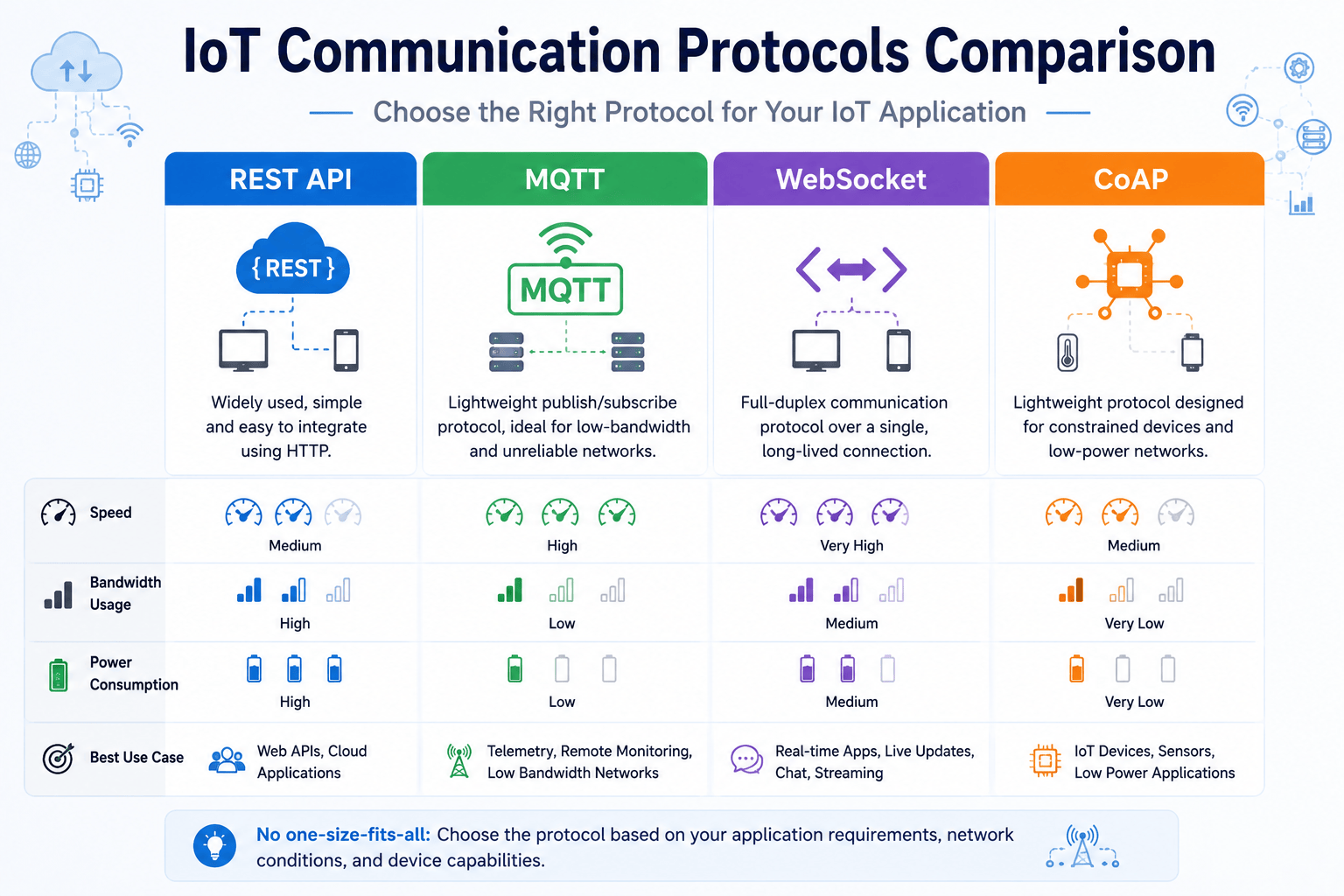
Communication APIs in IoT
Application Programming Interfaces, or APIs, allow IoT applications and devices to exchange information in a standard way.
Without APIs, applications would not be able to communicate with cloud services or connected devices.
Below are the most common APIs used in IoT.
REST API
REST APIs use HTTP to exchange information.
They are easy to build and are supported by almost every programming language.
Best for
- Mobile applications
- Web dashboards
- Smart home systems
WebSocket
WebSocket creates a continuous connection between two systems.
Instead of repeatedly requesting updates, information is delivered instantly whenever new data becomes available.
Best for
- Live monitoring dashboards
- Smart factories
- Traffic monitoring
MQTT
MQTT stands for Message Queuing Telemetry Transport.
It is one of the most popular communication protocols in IoT because it uses very little bandwidth.
It works especially well for devices with limited processing power.
Best for
- Smart homes
- Agriculture
- Industrial monitoring
- Remote sensors
CoAP
The Constrained Application Protocol was designed specifically for small IoT devices.
It consumes very little power while providing reliable communication.
Best for
- Battery powered sensors
- Environmental monitoring
- Healthcare devices
Common IoT Protocols
Communication protocols define the rules that devices follow while exchanging information.
Some of the most commonly used IoT protocols include:
| Protocol | Best Used For | Key Benefit |
|---|---|---|
| MQTT | Smart devices | Lightweight communication |
| HTTP | Web applications | Universal compatibility |
| CoAP | Low power devices | Low bandwidth usage |
| AMQP | Enterprise systems | Reliable messaging |
| Bluetooth LE | Wearables | Low energy consumption |
| Zigbee | Smart homes | Mesh networking |
| LoRaWAN | Agriculture | Long range communication |
Each protocol serves a different purpose, so choosing the right one depends on the application’s requirements.
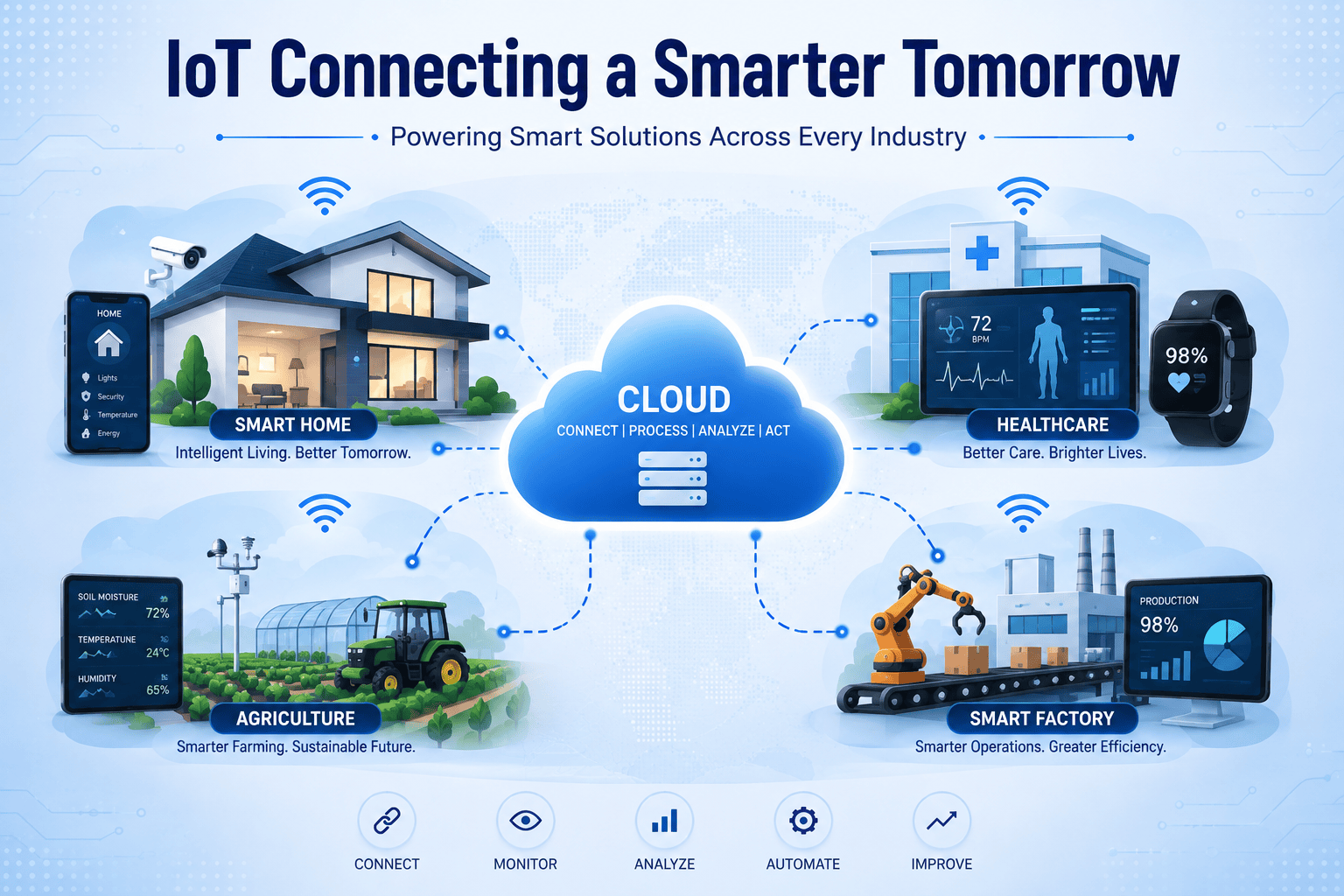
Real World Examples of Logical Design in IoT
Understanding logical design becomes much easier when you look at real applications.
1. Smart Home
Imagine arriving home after work.
Your smart lock unlocks the front door.
The lights automatically turn on.
The air conditioner adjusts the room temperature.
Your phone receives a notification confirming that you have arrived safely.
All of these actions happen because sensors, cloud services, communication protocols, and applications work together through the logical design of IoT.
2. Healthcare
Hospitals use wearable devices to monitor patients around the clock.
The wearable device collects heart rate, blood pressure, and oxygen levels.
The information is sent securely to cloud servers.
Doctors receive alerts if any reading goes outside the normal range.
This helps medical teams respond much faster during emergencies.
3. Smart Agriculture
Modern farms use IoT to improve crop production while reducing water usage.
Soil moisture sensors continuously monitor field conditions.
When the soil becomes dry, the irrigation system starts automatically.
Farmers can monitor everything from their smartphones without visiting the field.
4. Smart Manufacturing
Factories install sensors on production machines.
These sensors collect temperature, vibration, and performance data.
If a machine shows signs of failure, maintenance teams receive alerts before a breakdown happens.
This reduces downtime and improves productivity.
Advantages of the Logical Design of IoT
A well planned logical design offers many benefits.
- Improves communication between devices
- Supports real time monitoring
- Makes automation easier
- Helps systems grow without major changes
- Improves data accuracy
- Reduces manual work
- Simplifies remote monitoring
- Increases overall efficiency
- Strengthens security
- Makes troubleshooting easier
Challenges of the Logical Design of IoT
Despite its benefits, designing an IoT system comes with several challenges.
1. Security Risks
Connected devices can become targets for cyber attacks if they are not properly protected.
2. Device Compatibility
Different manufacturers may use different communication standards, making integration difficult.
3. Network Reliability
Poor internet connections can interrupt communication between devices.
4. Data Privacy
Sensitive user information must be stored and transmitted securely.
5. Scalability
Managing thousands of connected devices requires careful planning.
Best Practices for Designing an IoT System
Following best practices helps improve performance and security.
- Use encrypted communication whenever possible.
- Choose communication protocols based on your application.
- Keep device firmware updated.
- Monitor devices regularly.
- Use secure authentication methods.
- Store important data safely in the cloud.
- Design systems that can easily support future growth.
- Test the system before deployment.
Frequently Asked Questions
What is the logical design of IoT?
The logical design of IoT explains how devices, services, applications, and communication protocols work together to exchange information and provide useful services.
What is the difference between logical and physical design of IoT?
The physical design focuses on hardware such as sensors, gateways, and devices. The logical design focuses on software architecture, communication models, APIs, and data flow.
What are the functional blocks of IoT?
The main functional blocks are devices, communication, services, management, security, and applications.
Which communication model is most commonly used in IoT?
The Publish Subscribe model is one of the most popular because it supports efficient communication between many devices and works well with MQTT.
Which protocol is best for IoT?
There is no single best protocol. MQTT is widely used because it is lightweight and efficient, while HTTP, CoAP, Zigbee, and LoRaWAN are better suited for different types of applications.
Why are APIs important in IoT?
APIs allow applications, cloud platforms, and devices to exchange data using a standard interface. This makes integration easier and improves interoperability.
Conclusion
The logical design of IoT is the software foundation that allows connected devices to communicate, process information, and deliver useful services. It defines how data flows through an IoT system using communication models, APIs, protocols, and functional blocks.
Whether you are building a smart home, developing healthcare solutions, or creating industrial automation systems, understanding the logical design helps you build systems that are reliable, secure, and scalable.
As IoT continues to grow, knowing how these components work together will become even more valuable. By understanding the concepts covered in this guide, you will have a strong foundation for learning advanced IoT architecture and developing real world IoT applications.