
Think about the last time you called a business and heard “Press 1 for billing, press 2 for support.”
It can feel a little frustrating, and that’s exactly the moment voice AI is changing. Today, businesses can let an AI agent pick up the phone, understand what the caller actually means, and book an appointment or answer a question in a natural, friendly voice.
But choosing a provider isn’t easy. Every platform describes itself in a slightly different way, and the technical terms can make it hard to tell them apart.
So, this guide first explains how voice AI works in plain words. Then it walks through 5 providers worth a closer look, what each one does well, and which kind of team it suits best.
TL;DR
- Telnyx runs phone calls, speech and AI models on its own network, so your agent can call people around the world with local phone numbers.
- ElevenLabs focuses on expressive voices and lets you set up an agent from a simple prompt or a template.
- Deepgram combines listening, thinking and speaking in one API for developers who want control.
- Vapi gives builders one place to set up, test and track their voice agents.
- Retell AI is built around phone calls, with a visual builder, testing tools and live call monitoring.
How Voice AI Works, In Simple Terms
A voice AI agent works in three quick steps.
- First, it listens and turns the caller’s words into text, which is called speech-to-text.
- Next, an AI language model reads that text and decides what to say or do.
- Finally, it turns the answer back into a spoken voice, which is called text-to-speech.
All of this needs to happen in a split second. Otherwise, the caller hears an awkward pause.
That’s why providers work hard on speed, on letting callers interrupt naturally, and on connecting the agent to tools like calendars and CRMs, so it can actually get things done.
5 Voice AI Providers Worth A Closer Look
| Telnyx | ElevenLabs | Deepgram | Vapi | Retell AI | |
| Main Strength | Calls, speech and AI on its own network | Expressive voices and 90+ languages | One API for listening, thinking and speaking | Fast building and call tracking | Visual call builder and call center tools |
| How You Build | Mission Control Portal or APIs | Prompt or template, no code needed | API for developers | On-screen or with code | Drag-and-drop canvas |
| Compliance | SOC 2 Type II, HIPAA, PCI DSS, ISO 27001, GDPR | SOC 2, HIPAA, GDPR | HIPAA, GDPR | SOC 2, HIPAA, PCI | HIPAA, SOC 2 Type II, GDPR, ISO 27001 |
1. Telnyx
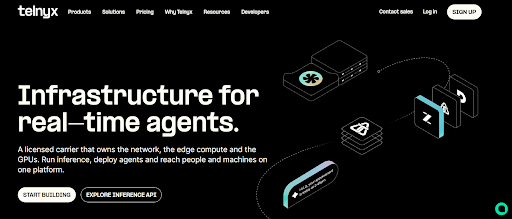
Telnyx is a communications company that lets you build voice AI agents on top of its own phone network.
How Telnyx’s Voice AI Works
Usually, a voice agent depends on several companies at once: one for phone calls, one for speech and another for the AI model.
Telnyx brings all of these into a single platform. Therefore, there are fewer handoffs between services, and the computers that run the AI sit right next to the phone network, which helps the agent reply in a fraction of a second. This matters because the best AI voice agents are the ones that reply quickly and sound natural, so callers feel like they’re talking to a real person.
You can set up an agent in the Mission Control Portal, where the AI Assistant Builder lets you describe how it should behave in plain language and test it in a browser simulator, or you can build it through the APIs.
Key Features
- Licensed carrier network: Telnyx places calls itself in more than 45 countries, so your agent can reach customers with a local caller ID.
- Global phone numbers: Telnyx says you can get phone numbers in more than 80 countries, all on Telnyx’s own network.
- Model and voice choice: You can use models hosted by Telnyx or bring in other providers, with transcription engines like Deepgram, Whisper, AssemblyAI and Speechmatics and more than a thousand voices.
- Easy switching for OpenAI users: If your team already builds with OpenAI’s tools, the same code works here with only small changes.
- Session Analysis: It lines up what the agent did with call quality data, so it’s easier to tell whether a problem came from the conversation, a tool or the phone line.
- Ready-made integrations: 30+ integrations across 13 categories let the agent work with the tools your team already uses.
- Compliance: Telnyx meets SOC 2 Type II, HIPAA, PCI DSS, ISO 27001 and GDPR requirements, which matters for fields like healthcare and finance.
Best For
Teams that want phone calls, speech and AI on one platform, with global reach and local phone numbers.
2. ElevenLabs
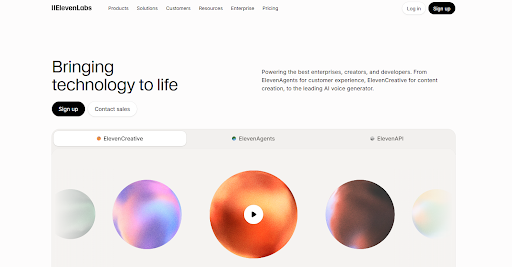
ElevenLabs is known for lifelike AI voices, and its agents platform puts those voices to work in real conversations.
How ElevenLabs’ Voice AI Works
You start from a short prompt or a prebuilt template. Then you upload documents and FAQs or connect a data source, so the agent answers with the right context. After that, you define workflows, actions and escalation paths without code.
Once the agent is live, a dashboard lets you track conversations and see where it can improve.
Key Features
- Large voice library: More than 10,000 voices are available, and you can even clone your own.
- Emotion-aware replies: Agents are designed to sound on-brand, respond at the right moment and adapt to how the customer is feeling.
- Multilingual support: Agents can detect and switch between more than 90 languages during a conversation.
- Everyday integrations: It connects with tools like Zapier, Stripe, Cal.com, Twilio, Zendesk and HubSpot, so an agent can book meetings, take payments or create tickets.
- Data control: Data is encrypted, and regional data residency and zero retention modes are available for stricter control.
Best For
Brands that care a lot about how their agent sounds and want to serve customers in many languages across voice and chat.
3. Deepgram
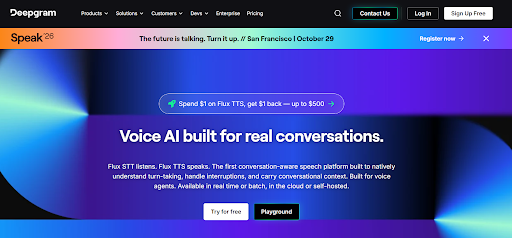
Deepgram is known for its speech models, and its Voice Agent API packs a full voice agent into one connection.
How Deepgram’s Voice AI Works
Instead of linking separate speech-to-text, AI and text-to-speech services yourself, you use one API that handles all three in real time. Because Deepgram makes its own speech models, the listening and speaking parts are built to work smoothly together.
Key Features
- Natural turn-taking: The API detects when a caller cuts in and predicts when it’s the agent’s turn to talk.
- Function calling: The agent can call functions to take actions during the conversation.
- Live adjustments: You can change the agent’s behavior while the session is still running.
- Bring your own model or voice: You can plug in your own AI model or voice and still let Deepgram handle the live back-and-forth of the call.
- Flexible hosting: Deepgram can host it for you, on servers used only by your company, in your private cloud or on your own machines.
- Compliance support: It supports HIPAA, GDPR and keeping data in a chosen region.
Best For
Developers and enterprises that want one API with deep control over models and where the agent runs.
4. Vapi
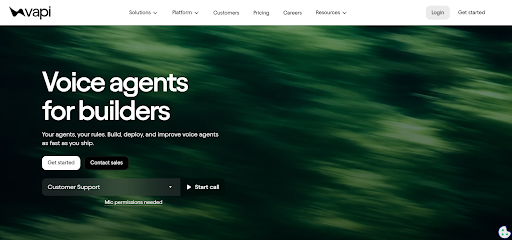
Vapi is a platform made for builders who want to move fast from an idea to a working voice agent.
How Vapi’s Voice AI Works
On Vapi, you set up everything in one place, from the voice and the conversation flow to the phone line and the integrations. Vapi takes care of the infrastructure behind it, so you can go from a prompt to a live agent quickly.
Moreover, once the agent is live, you can track how calls go, spot what needs fixing and keep improving it over time.
Key Features
- Built for developers: Everything you can do on screen can be done with code too.
- Access control: Single sign-on and role-based access mean each person only sees what they need.
- AI guardrails: Vapi says, built-in guardrails help keep the agent from making things up.
- Compliance: Vapi is SOC 2, HIPAA and PCI compliant.
- Scale and speed: Vapi says it can handle millions of calls with under 500 milliseconds of latency.
Best For
Developers and product teams that want to launch and keep refining voice agents quickly.
5. Retell AI
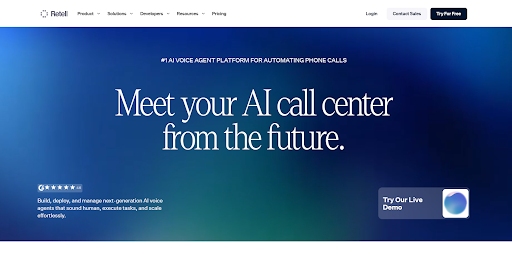
And finally, Retell AI is a voice agent platform designed especially for automating phone calls.
How Retell AI’s Voice AI Works
Retell AI gives you a drag-and-drop canvas where you map out every step of a conversation. You can add functions, integrations, call transfers, keypad presses (like “press 1 for sales”) and text messages. Before going live, you can simulate thousands of scenarios and turn real calls into tests, so problems show up early.
Key Features
- Phone menu navigation: The agent can recognize automated phone menus, press the right keys and reach the right destination during a live call.
- Outbound campaigns: You can schedule campaigns, control retries and let the agent handle voicemail.
- Smooth human handoffs: The AI briefs a human agent before passing the call over.
- Live monitoring: Supervisors can listen to calls live and take over at any moment.
- CRM connection: It pulls customer data from your CRM and writes call outcomes back afterward.
- Privacy controls: It can redact sensitive personal details from calls and transcripts.
- Compliance: Retell AI is HIPAA, SOC 2 Type II, GDPR and ISO 27001 compliant, and larger companies can run it on their own infrastructure.
Best For
Businesses that handle a lot of phone calls and want an AI call center they can build, test and monitor without much code.
Final Thoughts
Voice AI has become a practical way for businesses to answer calls, help customers and save their teams time.
The right provider depends on what matters most to you, whether that’s global phone reach, natural voices, developer control or call center tools.
- Telnyx suits teams that want calls, speech and AI on one network.
- ElevenLabs fits brands that put voice quality and languages first.
- Deepgram works well for developers who want one flexible API.
- Vapi helps builders launch and improve agents quickly.
- Retell AI is a good match for phone-heavy call centers.
So, try a demo or two, test them with your own calls, and pick the one that feels most natural for your customers.

