The right analytics platform for your business depends on what question you’re trying to answer, how technical your team is, how much data you’re actually working with, and what you can realistically afford. There’s no single “best” platform, only the one that actually fits your specific situation. Picking based on brand name or feature count alone is one of the most common and costly mistakes businesses make here.
we’ll walk through the factors that actually matter when making this decision, so you end up with a tool your team will actually use.
Start With the Question, Not the Tool
Before looking at any specific platform, get clear on what you actually need to know. Do you need to understand website traffic and behavior? Track marketing campaign performance across channels? Get a high-level view of overall business health? Predict future demand? Each of these points toward a different kind of tool, and starting with the question keeps you from getting distracted by flashy features you’ll never actually use.
If you’re still getting oriented on what these platforms generally cover, our beginner’s guide on what an analytics platform is is worth reading first.
Consider Your Team’s Technical Skill Level
A powerful platform is useless if nobody on your team can actually operate it. Some analytics tools are built for non-technical users, with simple dashboards and drag-and-drop reporting. Others assume familiarity with query languages or data modeling, and are built for teams with dedicated data analysts. Being honest about where your team actually falls on that spectrum will save you from buying something that ends up gathering dust.
Figure Out Scope: Broad or Focused
Some platforms are built to pull data from across your entire organization into one unified view. Others are more focused, specializing in a single area like web analytics or marketing performance. If you’re not sure which category actually fits what you need, our post on business intelligence vs analytics platforms breaks down that distinction in more detail.
Think About the Type of Analysis You Need
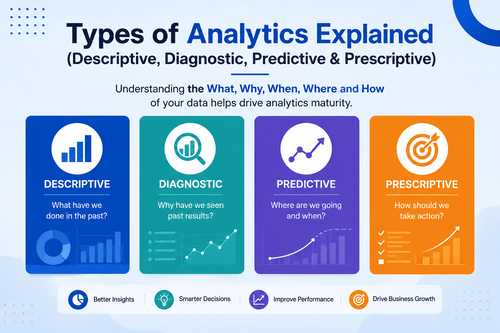
Some platforms mainly show you what already happened. Others go further, explaining why something happened or predicting what’s likely to happen next. If your business needs forecasting and predictive insight, not just historical reporting, that narrows your options considerably. Our post on types of analytics explained covers the different levels of analysis available and what each one is actually good for.
Check How Well It Integrates With What You Already Use
An analytics platform that doesn’t connect cleanly with your existing tools, your website, your CRM, your marketing software, creates extra manual work that defeats a lot of the purpose. Before committing to anything, confirm the platform integrates with the systems your business already relies on day to day.
Marketing-Specific Needs Are Worth Calling Out Separately
If your primary use case is tracking marketing performance specifically, rather than general business analytics, it’s worth looking at platforms built specifically for that purpose rather than a general-purpose tool. Our roundup of the best marketing analytics tools covers options built around that exact need.
Factor In Cost, Including the Hidden Kind
Pricing isn’t just the subscription fee. Factor in setup time, any training your team will need, and whether you’ll need to hire or contract someone with the technical skills to actually run the platform effectively. A cheaper tool that nobody knows how to use well ends up costing more in wasted time than a slightly pricier one your team can actually operate.
Test Before You Commit
Most reputable analytics platforms offer a free trial or a demo. Use it seriously, don’t just click around for five minutes. Load in some real data, try answering an actual business question you currently have, and see whether the platform gets you there without a fight. This is genuinely the best way to know whether a tool fits before you’re locked into a contract.
Quick Checklist
| Factor | What to Ask Yourself |
|---|---|
| Purpose | What specific question do I need this to answer? |
| Team skill | Can my team actually use this without extensive training? |
| Scope | Do I need broad organization-wide data or a focused view? |
| Analysis depth | Do I just need historical reporting, or also forecasting? |
| Integrations | Does it connect with tools I already use? |
| Cost | What’s the real total cost, including setup and training? |
Build Your Team’s Vocabulary First
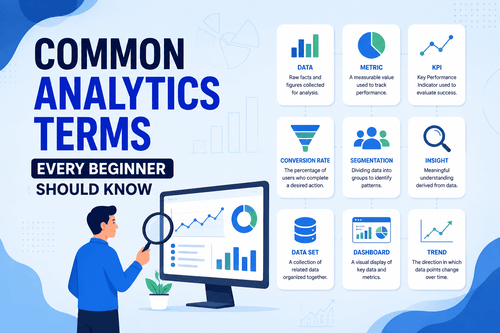
Even the best-fit platform is harder to use if your team isn’t familiar with the terminology analytics tools tend to use. Getting everyone on the same page before rollout makes onboarding considerably smoother. Our post on common analytics terms every beginner should know is a solid resource to share with your team ahead of adopting a new tool.
FAQs About Choosing an Analytics Platform
What’s the biggest mistake businesses make when choosing an analytics platform?
Picking based on features or brand recognition instead of starting with the actual business question they need answered, which often leads to paying for capability the team never ends up using.
Should small businesses use the same platforms as large enterprises?
Not necessarily. Smaller businesses are often better served by simpler, more affordable tools built for non-technical users, rather than a full enterprise-grade platform built for large, complex organizations.
How important are integrations when choosing a platform?
Very. A platform that doesn’t connect with your existing tools creates ongoing manual work that can eat into the time savings the platform is supposed to provide in the first place.
Should I choose a platform based on price alone?
No. The lowest-priced option isn’t necessarily the cheapest overall once you factor in setup time, training needs, and whether your team can actually use it effectively.
Is it worth using a free trial before committing to a platform?
Yes, and it’s worth testing it seriously with real data and a real business question rather than just briefly exploring the interface.
Do I need a platform with predictive analytics, or is descriptive reporting enough?
It depends on your needs. If you mainly need to understand what already happened, descriptive reporting may be sufficient. If you need to plan ahead based on forecasts, you’ll want a platform with predictive capability.